
American Airlines Seat Selection Guide: How to Choose the Best Economy Seats for Your Family
Seat types, fees and family-seating rules decoded — so you know when Main Cabin Extra or Preferred seats are actually worth paying for.
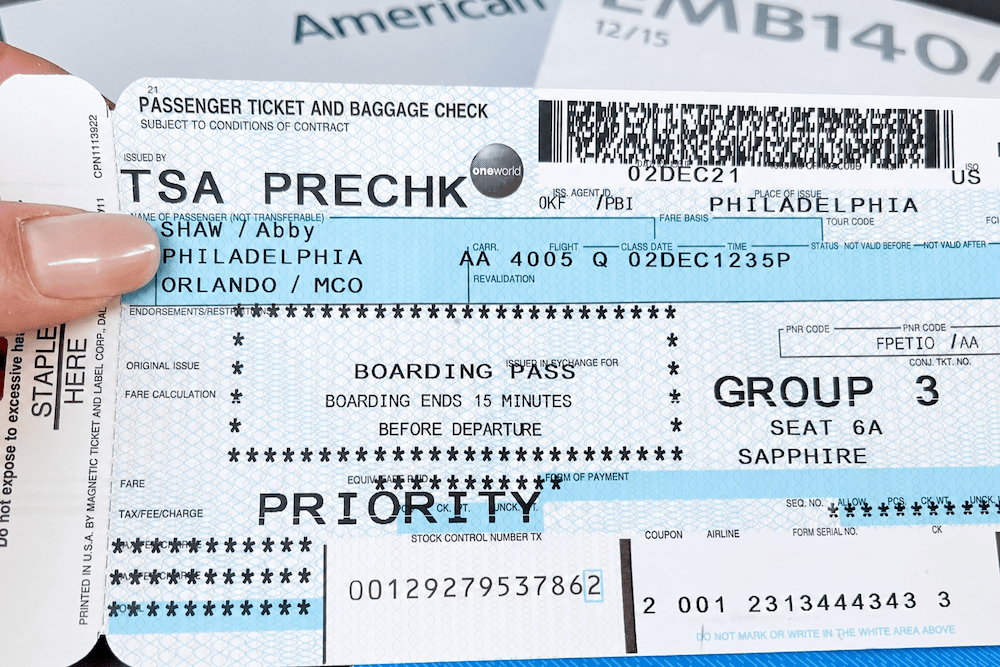
Booking an American Airlines flight can feel straightforward—until the seat map appears.
Some seats are free, others cost extra, and labels such as “Preferred” and “Main Cabin Extra” do not always mean what families expect. Add children to the reservation, and a simple booking decision can become stressful.
I learned this firsthand on a nonstop American Airlines trip from Philadelphia to Orlando in September 2024. We booked Basic Economy about three weeks before departure with our six-year-old and one-year-old lap infant. The flight was already so full that we could not find a row where our whole family could sit together.
I sat with both children while my husband paid about $30 more for an aisle seat two rows behind us. We politely asked the gate agent whether another arrangement had opened, but no workable seats remained. The flight was manageable, yet caring for both children without my husband beside me was far from ideal.
This guide explains American’s economy seat labels, family-seating rules and fees so you can decide when paying more will genuinely improve your trip.
The Quick Answer
Here is the simplest way to understand American Airlines economy seating:
- Basic Economy is a fare type, not a special section of the airplane.
- Standard Main Cabin seats usually have regular legroom and can be selected for free with a standard Main Cabin ticket.
- Preferred seats normally have standard legroom but sit in a part of the cabin American considers more desirable.
- Main Cabin Extra seats provide additional legroom and may include other benefits.
- Premium Economy is a separate cabin with wider seats and a more premium experience on select aircraft and routes.
For many budget-conscious families, a group of free standard Main Cabin seats together is a better purchase than several paid Preferred seats.
Main Cabin Extra becomes more appealing when the flight is long, someone needs additional legroom, you have a tight connection, or earlier boarding would meaningfully reduce your stress.
American Airlines Seat Types Compared
| Option | What it actually means | Extra legroom? | Seat selection |
|---|---|---|---|
| Basic Economy | American’s lowest Main Cabin fare with additional restrictions | Depends on the seat assigned or purchased | Pay for a specific seat or receive an assignment |
| Standard Main Cabin | A regular economy seat | Usually no | Generally free with a Main Cabin fare |
| Preferred | A regular-legroom seat in a location American considers favorable | Usually no | Often requires a fee |
| Main Cabin Extra | An economy seat with more legroom and added benefits | Yes | Often requires a fee |
| Premium Economy | A separate premium cabin on select flights | Yes, with a wider seat | Included with a Premium Economy ticket |
Basic Economy Is a Fare, Not a Seat
A Basic Economy passenger does not sit in a separate Basic Economy section. You will still sit somewhere in the Main Cabin. What changes are the rules surrounding your ticket and seat selection.
For Basic Economy tickets purchased on or after May 18, 2026, American allows passengers to select a specific seat for a fee. If you do not pay to choose one, American will normally assign a seat for free at check-in or at the departure gate. American also states that it cannot generally guarantee companions on the same ticket will sit together, although its separate family-seating policy may apply to children.
This creates an important family decision:
Suppose Basic Economy saves your family $35 per person, but selecting acceptable seats costs $28 per person. The apparent $140 saving for a family of four may shrink to only $28. Before choosing Basic Economy, compare the complete family cost, not merely the first price displayed in the search results.
What Basic Economy cost our family
For our Philadelphia-to-Orlando trip, each round-trip airfare was about $300 before bags and taxes. Our one-year-old traveled as a lap infant, so we purchased three tickets rather than four.
Seat-selection fees were additional. Because the remaining seats were scattered, my husband paid about $30 more than I did for an aisle seat that placed him two rows behind us. Even after paying to choose seats, we still could not put the whole family in one row on the outbound flight.
That is why I now compare Basic Economy plus seat fees against the price of Main Cabin. A fare that looks cheaper at first can become much less appealing once you add the cost of selecting acceptable seats for every ticketed traveler.
Standard Main Cabin Seats
A standard Main Cabin seat is the ordinary economy option. When you purchase a Main Cabin fare, American says you can choose an available standard seat for free when you book. You can also pay for a Preferred or Main Cabin Extra seat.
For many families, standard Main Cabin is the best balance between price and control because it lets you choose seats without paying for every person.
A free standard seat may be the right choice when:
- The flight is relatively short.
- Your family can sit together.
- No one needs additional legroom.
- You do not have a particularly tight connection.
- You would rather put the money toward meals, baggage or activities at your destination.
Do not assume that every free seat is a bad seat. A standard seat a few rows behind the Preferred section may provide nearly the same experience for no additional charge.
What Is a Preferred Seat?
A Preferred seat is a standard-legroom Main Cabin seat in a location American considers more desirable, often near the front or in a popular part of the cabin. It is primarily a location upgrade, not a comfort upgrade.
Before paying, ask what problem the seat solves. A Preferred seat may be worthwhile when it:
- Keeps your family together.
- Places you closer to the exit for a tight connection.
- Gives you a needed aisle or window.
- Moves you away from a lavatory or galley.
- Is the only acceptable option remaining.
I compare the actual row with the nearest free standard seat. If a free seat two or three rows back offers nearly the same experience, the Preferred label alone is not enough reason to pay.
What Is Main Cabin Extra?
Main Cabin Extra is American Airlines’ extra-legroom economy product. As of August 1, 2026, American advertises Main Cabin Extra seats starting at $20, although actual prices vary by flight and seat. Benefits can include:
- More legroom.
- Preferred Group 5 boarding.
- Earlier access to overhead-bin space.
- Complimentary beer, wine and spirits on flights with full drink service.
- Standard complimentary snacks, soft drinks and entertainment.
Main Cabin Extra remains part of the Main Cabin. It is not the same as Premium Economy, First Class or Business Class.
A benefit that is easy to misunderstand
American lists a carry-on bag as part of the Main Cabin Extra experience, but a carry-on bag and personal item are also included with regular Main Cabin and Basic Economy tickets.
Main Cabin Extra and Basic Economy
You can purchase a Main Cabin Extra seat while traveling on a Basic Economy ticket, but the seat purchase does not by itself provide Group 5 boarding. American lists Main Cabin Extra in Group 5 while specifically excluding Basic Economy.
You may still receive an earlier group through another qualifying benefit, such as AAdvantage status, earning 15,000 Loyalty Points or holding an eligible AAdvantage credit card. Check the group printed on your boarding pass rather than assuming the seat automatically changes it.
Main Cabin Extra Versus Preferred
This is the comparison that matters most to many travelers.
| Feature | Preferred | Main Cabin Extra |
|---|---|---|
| More legroom | Usually no | Yes |
| Better cabin location | Often | Often |
| Earlier boarding | Not necessarily | Group 5, except Basic Economy unless another benefit applies |
| Complimentary alcoholic drinks | No special benefit | On eligible flights with full drink service |
| Located in Main Cabin | Yes | Yes |
| Usually costs extra | Yes | Yes |
Choose Preferred when location is the main benefit you need. Choose Main Cabin Extra when the additional space or boarding benefit has enough value to justify the price. Choose standard Main Cabin when neither paid option solves a meaningful problem.
Is Main Cabin Extra Worth It?
Its value depends on the price, flight length and traveler. A $25 upgrade on a six-hour flight is very different from the same fee on a 55-minute flight—especially when you are paying for several family members.
The “Is it worth it?” formula
First calculate the full cost:
A $28 seat for four people on two segments costs:
Then calculate the cost per upgraded passenger-hour:
For four people paying $28 each on a three-hour flight:
“Passenger-hours” means the flight time multiplied by the number of people receiving the paid seat. This helps you compare a short flight with a longer one instead of judging both upgrades by the fee alone.
Use these practical—not airline-defined—ranges as a starting point:
- Under $8 per person per hour: Often attractive when the space or location genuinely helps.
- $8–$15: Situational; consider height, flight length, connection risk and family needs.
- Over $15: Usually hard to justify on a short flight unless it solves an important problem.
Main Cabin Extra may be more worthwhile when the flight is long or overnight, a traveler is tall or uncomfortable in restricted spaces, you have a tight connection, you are traveling with a lap child and value the extra usable space, or earlier boarding would reduce concern about overhead-bin space.
It may be less worthwhile when standard seats are available together, the flight is short, the row has fixed armrests or limited recline or reduced storage, you already receive earlier boarding through status or a credit card, or the fee must be multiplied across several travelers and segments.
American Airlines’ Family Seating Policy
American says children 14 and under will be seated adjacent to an accompanying adult without an additional charge when these conditions are met:
- Everyone is on the same reservation.
- Adjacent seats are available in the child’s ticketed class of service when booking.
- You select seats for everyone or skip selection for everyone; Basic Economy families relying on the policy should skip seat selection for the entire reservation.
- You do not change the assignments American provides.
- The aircraft can accommodate the group and is not changed to a smaller plane.
If the conditions are not met, American says it will still try to place each child beside an adult.
What the policy does not guarantee
The policy is intended to prevent a young child from sitting alone. It does not promise that the whole family will share a row, receive Preferred or Main Cabin Extra seats, or keep the same assignments after an operational change.
Book every adult and child on one reservation whenever possible. When separate bookings are unavoidable—perhaps because of points, credits or work travel—contact American early and ask Reservations to link or note them.
Should families pay to select seats?
Paying may be worthwhile when you need one row, require a specific setup for a car seat or medical need, or see only a few suitable groups remaining. Waiting may be reasonable when the policy applies, fees would substantially increase the fare and you are comfortable splitting into adult-and-child pairs.
Remember that paying cannot create seats that are no longer available. My husband paid more for the closest practical aisle seat, yet the full flight still left him two rows behind us. If you rely on automatic family seating, avoid partial or scattered assignments that may restrict the available options.
Exit-Row Restrictions for Families
Exit-row Main Cabin Extra seats may provide appealing legroom, but passengers must be at least 15 and able and willing to perform the required emergency duties.
Also remember that exit-row seats can have tradeoffs, including fixed or restricted armrests, reduced recline in certain rows, no under-seat storage during takeoff and landing in some locations, a colder or busier environment near the exit, and requirements that make the row unsuitable for some travelers.
Extra legroom does not automatically make every exit-row seat a good family seat.
How I Choose Seats When Traveling With Children
Our Philadelphia-to-Orlando trip changed my approach. Now I use this process:
- 1Compare the complete fare. I price three versions of the itinerary: Basic Economy plus any seats we would pay to select; Main Cabin with standard seat selection included; and Main Cabin plus any Preferred or Main Cabin Extra seats we genuinely want. Main Cabin can be the better value once Basic Economy seat fees are added. I also look for opportunities to redeem miles for Main Cabin tickets so we have more control without paying for each seat separately.
- 2Define the seating need. Decide whether everyone must share a row or whether adult-and-child pairs would work. Consider car seats or a lap infant, aisle and window needs, traveler height and comfort, flight length and connection time, and how much help one parent will need during the flight. This separates a genuine family need from a preference that may not be worth multiplying across passengers and segments.
- 3Study the row, not the label. Compare paid seats with nearby free options and check recline, storage, lavatory location and the overall family arrangement. On our Orlando flight, my husband’s aisle seat mattered mainly because it was one of the closest available—not because it was more comfortable.
- 4Save the assignment. Screenshot passenger names, seat numbers, the aircraft or seat map and any fees. This will not prevent a change, but it documents what you purchased.
- 5Recheck at useful times. Review the reservation after schedule or equipment notifications, about a week before departure and again when check-in opens. The goal is not constant refreshing; it is catching a problem while there is still time to address it.
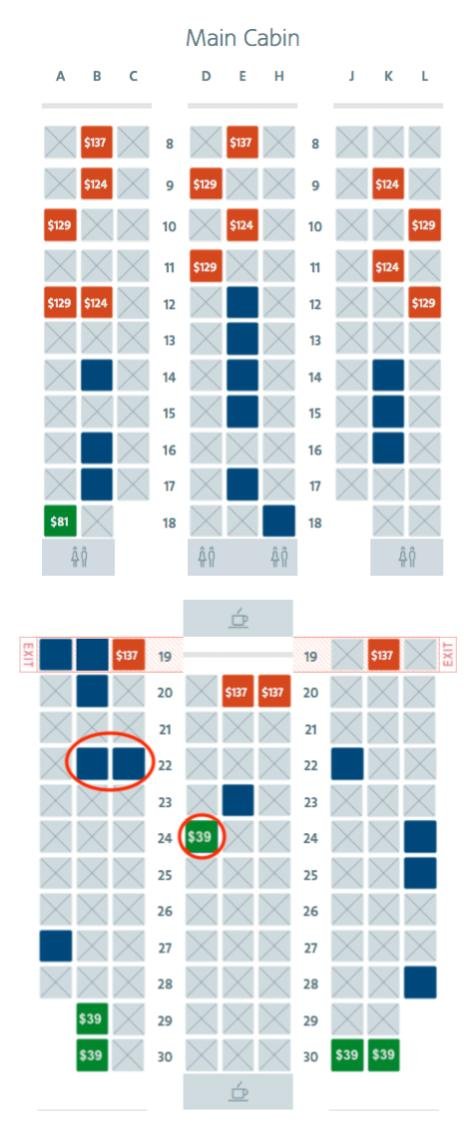
How to Read the American Airlines Seat Map
The seat-map color and price are only the beginning. Check these details before paying:
Location
A seat near the front can help with a tight connection. When the flight ends at your destination, leaving the aircraft a few minutes sooner may not justify a large family-wide fee.
Window, middle or aisle
Think about how your family will function. One adult with two younger children may prefer the middle seat to help both. Two adults and two children may work well as pairs across the aisle.
Lavatories and galleys
Nearby rows can bring noise, light, odors, foot traffic and passengers waiting beside your seat. Quick restroom access may still be useful during toilet-training years or for someone who needs frequent access.
Bulkheads
Bulkhead rows may have fixed armrests, tray tables stored in the armrests and no floor storage during takeoff and landing. That matters when you want a diaper, snack or entertainment bag at your feet.
Recline and under-seat space
Seats in front of exit rows or at the back of a cabin section may have limited recline. Entertainment equipment or structural supports can also reduce space for personal items.
The operating airline
Confirm that the flight is operated by American Airlines or American Eagle. A flight sold with an American number may be operated by a partner with different seat maps, products and family procedures.
Best American Airlines Seats for Different Travelers
| Traveler | Best starting point |
|---|---|
| Family with young children | Prioritize sitting beside the children over being near the front. Choose suitable seats early and remember that exit rows are not available to families traveling with a child under 15. |
| Tall traveler | Main Cabin Extra is usually the most relevant economy option, but inspect the exact row for limited recline, fixed armrests or reduced storage. |
| Budget-conscious family on a short flight | Standard Main Cabin seats together are often the best value. Moving only a few rows forward may not improve a short trip enough to justify several fees. |
| Traveler with a tight connection | Consider a Preferred or Main Cabin Extra seat that is genuinely near the exit, especially at a large connecting airport. Do not rely on the label alone. |
| One parent with two children | In a three-seat section, the parent may prefer the middle so they can help both children. The youngest can sit at the window and the more independent child on the aisle. |
| Family of four | Two adult-and-child pairs across the aisle can work better than placing three together and separating one adult. Each child still has an adult immediately beside them. |
| Nervous traveler | Choose the window, aisle or cabin location that addresses your specific anxiety. The best choice may be near the wing, closer to the front or somewhere that feels less enclosed. |
What to Do When Your Family’s Seats Are Separated
Do not wait and hope the issue resolves itself.
Before the airport
- 1Review the seat map in the app and on the website.
- 2Identify which child is not beside an adult and note the child’s age.
- 3Determine whether the separation existed at booking or followed an itinerary change.
- 4Contact American if travelers are on separate bookings or the assignment does not meet the family-seating policy.
- 5Save screenshots and check periodically for suitable openings.
Seats held for operational needs may open later, but treat that as a possibility rather than a plan. First ensure every young child is beside an adult; then ask whether the rest of the family can move nearby.
At the airport
Arrive early enough to speak with an agent before boarding and make a calm, specific request:
On our Orlando trip, the gate agent checked after we explained that I had both children while my husband sat two rows behind. The flight was too full for a workable change. Asking respectfully was worthwhile, but an agent cannot create space that does not exist.
Requesting a passenger swap
Offer an equivalent or better seat and do not expect someone to surrender a paid aisle, window or extra-legroom seat for a worse one. Ask a flight attendant for help rather than reorganizing the cabin during boarding.
What Happens After an Aircraft Change?
American says it tries to preserve seat assignments or provide similar seats after schedule and equipment changes, but assignments are not guaranteed.
A replacement aircraft may have fewer rows or a smaller cabin, a different aisle configuration, fewer Main Cabin Extra seats, or no equivalent window, aisle or exit-row position. An automated rebooking may also move passengers individually rather than preserving the original family grouping.
After any itinerary notification, check:
- 1Does every passenger still have a seat?
- 2Is each child still beside an adult?
- 3Did an aisle or window become a middle seat?
- 4Did a paid Main Cabin Extra seat become a standard or Preferred seat?
- 5Are the new seats in the same cabin?
- 6Was any lost seat fee automatically refunded?
Addressing the problem before travel is usually easier than discovering it at the gate.
Are American Airlines Seat Fees Refundable?
Paid seat fees are generally nonrefundable when you voluntarily move to a cheaper or free seat or make certain voluntary changes.
A refund may be available when:
- You upgrade to First or Business.
- You purchase a more expensive seat on the same flight.
- You cancel within the eligible 24-hour booking period.
- You cancel, rebook and purchase seats on the new flight.
- American cancels your flight, causes a missed connection or denies boarding on an oversold flight—and cannot provide a comparable seat.
For Main Cabin Extra, a non-comparable replacement includes a move to Preferred or standard Main Cabin, or from an aisle/window Main Cabin Extra seat to a middle seat. For Preferred, it includes a move to a non-Preferred seat or from a Preferred aisle/window to a Preferred middle.
A Practical Seat-Selection Decision Tree
Use this order when deciding:
- 1Are you traveling with children 14 or younger? Decide whether you need the whole family in one row or simply each child beside an adult.
- 2Are acceptable standard seats available for free? Choose them unless a paid seat solves a specific problem.
- 3Would Basic Economy still be cheaper after seat fees? Compare the complete family cost with Main Cabin.
- 4Is a Preferred seat offering real value? Pay only when its location, aisle, window or grouping improves the trip.
- 5Is Main Cabin Extra reasonably priced? Calculate the total family cost and cost per passenger-hour, then weigh the legroom and boarding benefits.
- 6Are you relying on family seating? Follow American’s stated eligibility conditions.
- 7Did the itinerary change? Review the assignments and any paid-seat benefits.
Frequently Asked Questions
Official American Airlines Policy Sources
Airline policies, prices and benefits can change. The following official American Airlines pages were reviewed on August 1, 2026:
Final Advice for Families
The seat map is designed to sell choices, not necessarily to identify the best value for your family. Ask what problem each paid seat will solve.
Our Philadelphia-to-Orlando trip showed that availability matters as much as willingness to pay. We booked about three weeks ahead, paid for seats and still could not sit together on the outbound flight. I managed our six-year-old and lap infant while my husband sat two rows behind; the return was easier because three seats together were available.
For our family, the better approach is to:
- Book early for busy routes.
- Compare Basic Economy plus seat fees with Main Cabin.
- Decide the required seating arrangement before opening the map.
- Redeem miles for Main Cabin when it includes the standard seats we need.
- Pay more only for a meaningful benefit.
- Save and recheck assignments before travel.
Planning almost a year ahead for a later Walt Disney World trip on another airline gave us more control over both cost and seating. We redeemed about 9,000 points per person each way. The airline rules were different, but the lesson was the same: starting early expands your options.
Once you understand the labels and calculate the full family cost, you can choose based on your family’s needs rather than the color assigned to the seat.